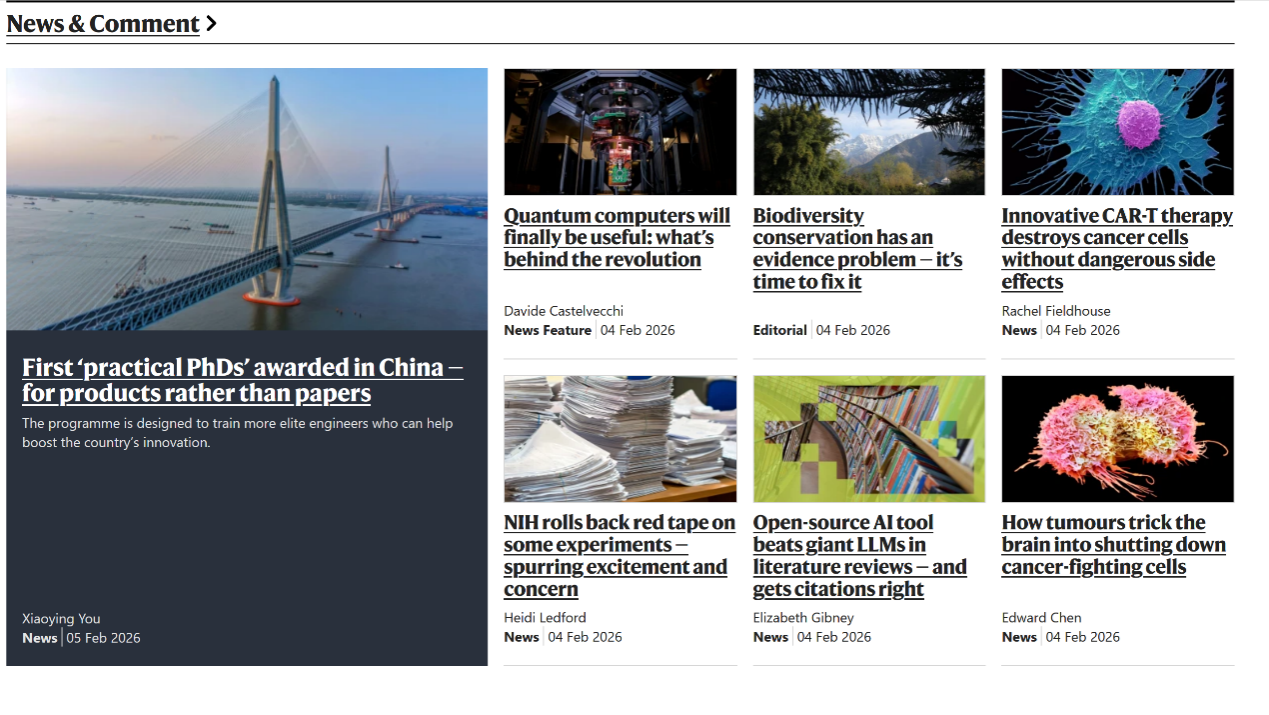
Recently, the international leading journal Nature ran a headline story in its News & Comment section titled “First ‘practical PhDs’ awarded in China — for products rather than papers”, featuring Zheng Hehui, one of the first cohort nationwide—and the first case in Jiangsu Province—to apply for a doctoral degree based on practical outcomes rather than a traditional dissertation.
Zheng Hehui is jointly supervised by Professor Liu Zhao, the academic lead of the Bridge Engineering discipline at the School of Civil Engineering, Southeast University, and Chief Scientist Zhang Hong, Chief Engineer at CCCC Second Harbor Engineering Co., Ltd. Focusing on key challenges in industrialized and intelligent bridge construction, Zheng delivered a major practical achievement titled “Modularized Rebar Design and Engineering Application for Ultra-High Concrete Bridge Towers.” The achievement has been successfully applied to several national landmark projects, including the Changtai Yangtze River Bridge (the world’s largest-span road–rail cable-stayed bridge).
In an interview with Nature, Professor Guo Tong, Dean of the School of Civil Engineering, noted that evaluating doctoral candidates through practical outcomes can encourage students to conduct research that tackles real problems in strategically important industries and those with technological bottlenecks.
At the practical-outcome evaluation meeting on January 4, 2026, Jin Shi, Vice President of Southeast University, remarked that Zheng’s work vividly embodies the idea of “writing papers on the land of our motherland.” He emphasized that this practice-oriented training model—aimed at addressing “bottleneck” challenges in major national projects and serving China’s transportation-powerhouse strategy—represents an innovative implementation and important breakthrough in response to China’s new Degree Law.
As one of the early institutions in China to develop professional degree education in engineering, the School of Civil Engineering at Southeast University has long aligned its graduate training with national strategic needs. The school is committed to cultivating high-level talents with strong technological innovation capabilities and the ability to solve complex engineering problems, and has trained more than a thousand engineering master’s and doctoral graduates who have contributed to major national projects such as the Hong Kong–Zhuhai–Macao Bridge, FAST, and the Shenzhen–Zhongshan Link. Graduates have also led over 60 major engineering projects in countries including Kenya, Senegal, and Mozambique under the Belt and Road Initiative.
Link to the Nature article: (as provided)https://www.nature.com/articles/d41586-026-00356-8