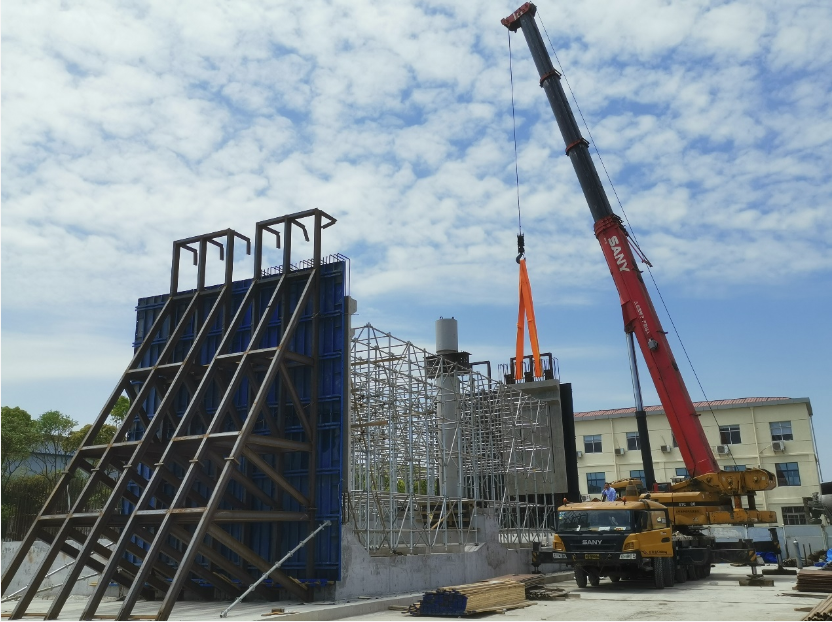
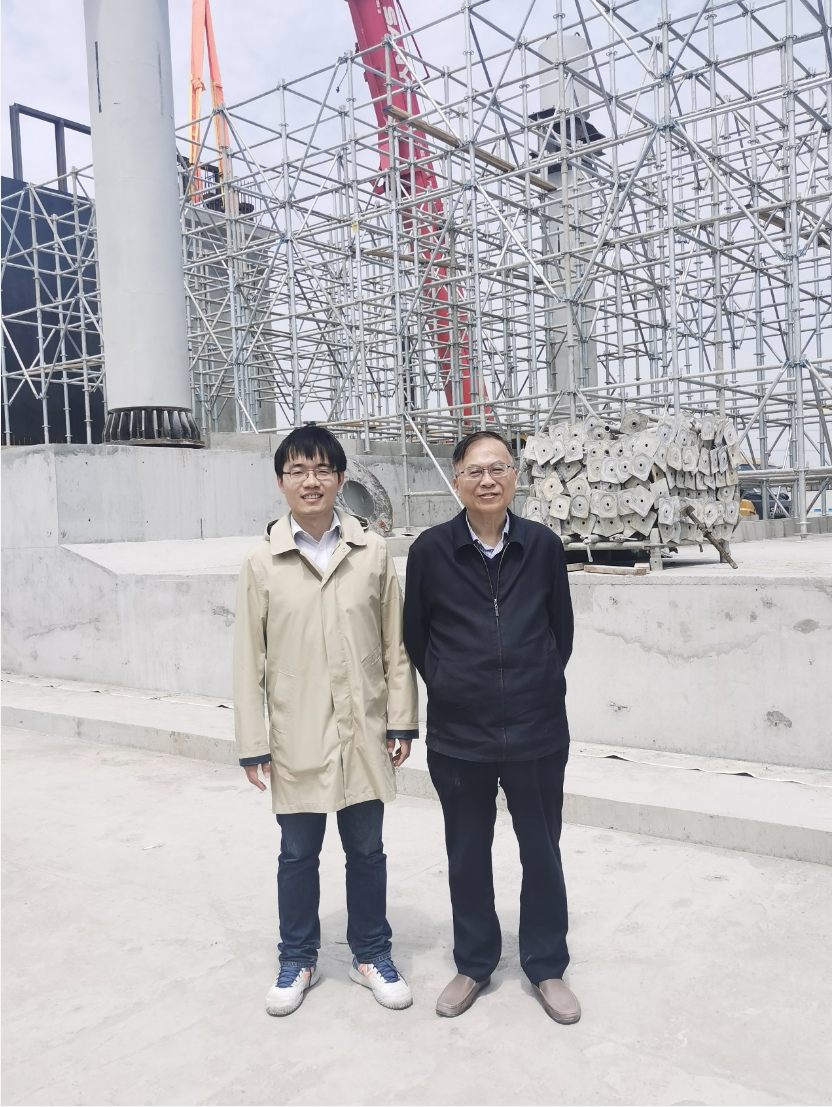
In April 2021, the team led by Guo Zhengxing and Guan Dongzhi from our school initiated the construction assembly trial of the “New Assembly Composite Integral Underground Station Structure System” at the base of Wuxi Municipal Construction Group. This trial aims to verify the construction feasibility of the system, further refine and enhance its structure, and lay the foundation for the construction of subsequent pilot stations. This marks the substantive construction phase of the system.
Traditional methods for constructing underground stations in soft soil conditions often involve the open-cut excavation method with lateral bracing support. However, it is challenging to apply conventional prefabricated underground station structures in such scenarios. Through collaborative efforts with Wuxi Metro Group Co., Ltd., and China Railway Fourth Survey and Design Institute Group Co., Ltd., our school has developed a new type of assembly composite integral underground station structure system. This system combines prefabrication and in-situ casting, allowing for the construction of prefabricated underground stations in open-cut excavations on soft soil foundations. The approach maximizes the advantages of both in-situ casting and prefabricated structures, enhancing overall structural integrity, waterproofing, and durability. After nearly two years of experimental research, the system has met the necessary conditions for practical construction and will be applied to the construction of the Nanmen Station on the Wuxi to Jiangyin intercity rail transit XiCheng segment.
The “New Assembly Composite Integral Underground Station Structure System” represents another significant achievement in our school's research in new building industrialization. It introduces a new model for the construction of underground stations under the conditions of “soft soil foundation and lateral bracing open-cut excavation,” providing a new approach for the construction of underground stations in our province and even nationwide.